
Sherwani for Men & Grooms
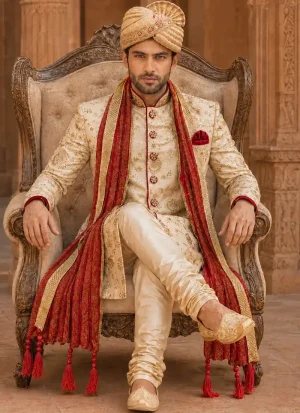
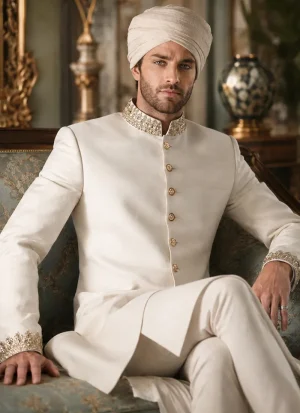
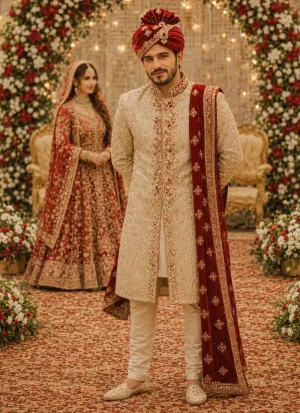
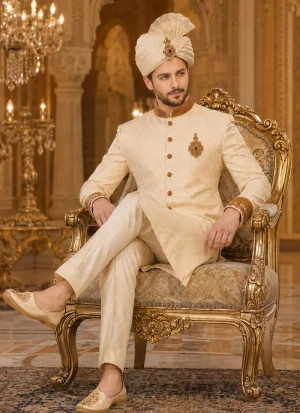
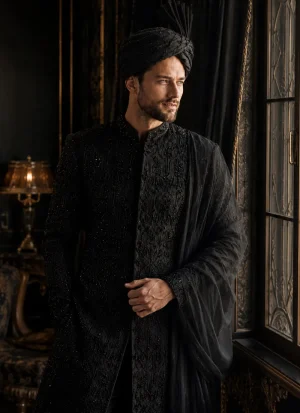
The sherwani is the long, structured coat worn by grooms and male guests at Pakistani and wider South Asian weddings, and it is the garment this Shadi Dress collection is built around — a fitted body, a stand or band collar, and surface work that ranges from almost invisible to openly metallic depending on the piece. The sherwanis here are made in Silk Jamawar, in colours running from black and grey through beige, cream, ivory and white, alongside a golden sherwani lifted with deep red.
If you are dressing for a Nikkah, Baraat or Walima in the UK, browse the range below and open the individual listings. Each one sets out its own embroidery, detailing and sizing information, which matters when you are buying formal menswear against a fixed date.
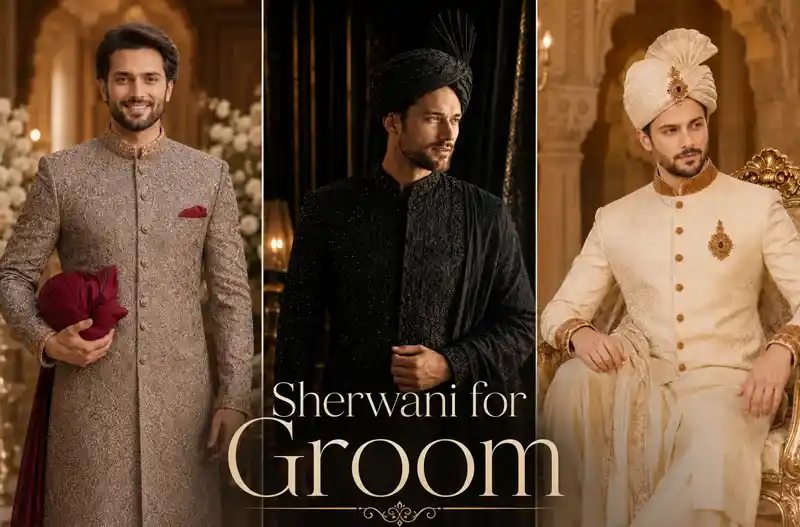
Showing all 10 resultsSorted by latest
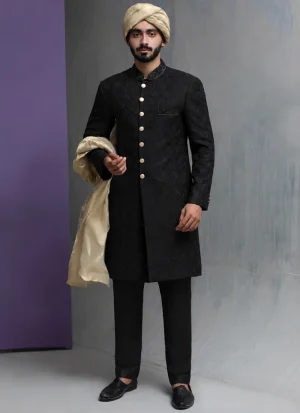
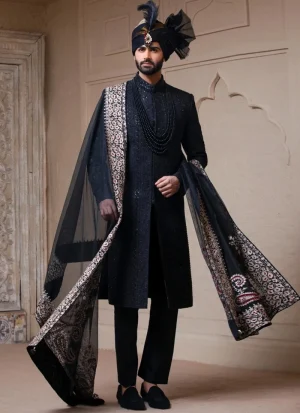
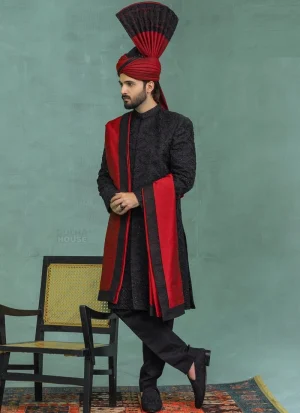


Showing all 10 resultsSorted by latest
How to Choose a Sherwani as the Groom
Settle the depth of colour first, then the embroidery, then the fit. A dark sherwani in black or grey reads as formal and holds its shape under evening lighting; ivory, cream and white sit lighter and tend to suit daytime functions and outdoor settings. Once colour is decided, the amount of surface work does the rest — a tonal, close-worked sherwani stays quiet next to a heavily embroidered bridal outfit, while gold zari at the collar and cuffs gives contrast without covering the whole coat.
Fit is the part most grooms leave too late. A sherwani is a structured garment, so the shoulder line, chest and overall length shape the silhouette far more than embroidery does.
Silk Jamawar, Embroidery and Zari — What the Terms Actually Mean
The sherwanis in this collection are made in Silk Jamawar. That is the fabric: the woven base, with its own weight and subtle pattern. It is separate from whatever is worked on top of it, and the two are often confused.
The surface detail varies by piece, and these terms are not interchangeable:
- Hand embellishment — raised work applied by hand, using elements such as kora, dabka, sequins and pearls. Hand embellishment on parts of a garment is not the same thing as a fully hand-embroidered coat.
- Machine threadwork — even, repeatable thread embroidery, frequently combined with hand-applied elements on the same sherwani.
- Tonal embroidery — embroidery in the same shade as the cloth, so the pattern registers as texture rather than colour. The black and grey sherwanis take this approach.
- Gold zari — metallic thread used on defined areas such as a collar or cuffs. Zari is a specific material, not a catch-all term for gold-coloured embroidery.
Each product page states what has been used on that particular sherwani. It is worth reading, because two coats in the same colour family can look completely different depending on how dense the work is and where it has been placed.
Colour Across Nikkah, Baraat and Walima
No colour is compulsory for any of the three functions. What usually guides the choice is formality, the hour of the event and the bride’s palette.
Ivory, cream and white are frequently chosen for Nikkah, particularly for daytime ceremonies, where gold detailing lifts them without making them loud. Baraat tends to be the most dressed of the three, which is where richer colour and heavier work sits comfortably — gold with red accents, or a strong black. Walima is often handled a little more quietly, and beige, grey or tonal embroidery suits that mood. These are starting points rather than rules; plenty of grooms reverse them entirely.
Explore Sherwanis by Colour and Finish
Current colours in the collection, each with its own detailing:
- Grey sherwani with hand embroidery — tonal work using kora, dabka, sequins and pearls
- Beige sherwani with hand embroidery — a neutral base with tonal hand and machine work
- Black-on-black sherwani — embroidery in the same shade as the cloth, read as texture
- Cream sherwani with gold zari — gold thread embroidery with zari at the stand collar and cuffs
- Golden sherwani with red accents — gold embroidery cut through with deep red
- White sherwani with a gold zari collar — a clean body with gold concentrated at collar and cuffs
- Ivory sherwani with gold embroidery — gold thread work, a zari collar and red detailing
Coordinating the Groom’s Sherwani with the Bride
The useful conversation to have early is which of you is wearing the heavier embroidery. If the bride’s outfit is densely worked in gold, a tonal sherwani in grey, beige or black lets the two sit together instead of competing. If her outfit is lighter or more restrained, the groom can carry more visible zari.
Undertone matters as much as colour name. Warm gold on a sherwani reads awkwardly against silver or antique-silver bridal work, and an ivory coat next to a bright white lehenga can look like a mismatch rather than a pairing. If you are choosing both outfits together, it helps to look at Pakistani bridal dresses alongside the sherwanis, and at Nikkah dresses or Walima dresses when you are planning function by function.
Styling a Sherwani: Kurta Pyjama, Turban, Shawl and Khussa
A sherwani is worn over a kurta and pyjama, so the base layer should be considered part of the outfit rather than an afterthought. A pagri or turban raises the formality and is most commonly seen at Baraat. A shawl or stole draped over one shoulder adds weight to the silhouette and photographs well on a stage. Footwear is usually khussa or a formal closed shoe, chosen to sit with the metal tone of the embroidery rather than against it.
Accessories are not automatically supplied with a sherwani. Check the individual product page to see exactly what is included before assuming a turban, shawl or inner kurta comes with it.
Sizing, Measurements and Ordering to a Wedding Date
Take chest, waist, shoulder width, sleeve length and full garment length before you order, and compare them against the Shadi Dress size guide rather than relying on the size you usually wear in a Western suit. Sherwani proportions are cut differently, and length in particular is a matter of preference — some grooms want it well below the knee, others closer to mid-thigh.
Sizing options and any customisation differ from product to product, so read the listing carefully and ask before ordering if something is not clear.
Wedding clothing is bought against a fixed date, which makes timing part of the decision. Order with enough room for delivery and for any local alterations you may want once the sherwani arrives. Current delivery details are on the delivery information page.
Frequently Asked Questions About Sherwanis
What is a sherwani?
A sherwani is a long, structured formal coat worn by men at South Asian weddings. It usually has a stand or band collar, a fitted body through the chest and waist, and a length that falls below the knee. It is worn over a kurta and pyjama, and it is the standard choice for a groom at Nikkah, Baraat and Walima.
What is the difference between white, ivory and cream sherwanis?
The difference is undertone. The white sherwani is the coolest and brightest of the three. The ivory sherwani is a warmer off-white, which softens under evening light. The cream sherwani is warmer still, with a yellow base that sits closely with gold work. If the bride is in bright white, ivory or cream can look mismatched beside her rather than coordinated.
Can a groom wear a black sherwani at a Pakistani wedding?
Yes. Black is an established groom colour, particularly for evening functions and receptions, and black-on-black embroidery gives detail without brightness. Some families hold their own preferences about colour on specific days, so it is worth a quick conversation before ordering.
What fabric are the Shadi Dress sherwanis made from?
The sherwanis in this collection are made in Silk Jamawar. The embroidery and embellishment applied over it differ by piece, so the fabric stays consistent while the surface detail does not. Each product page lists what has been used on that garment.
Is zari the same as gold embroidery?
No. Zari is metallic thread, used here on defined areas such as a collar or cuffs. Gold-coloured embroidery can also be worked in ordinary threads, which gives a softer, less reflective finish. The product description will tell you which applies to a specific sherwani.
Does a sherwani come with a turban, shawl or khussa?
Only where the listing states it. Inclusions vary between products, so check the individual product page for what is supplied rather than assuming accessories are part of the set.
Can I order a sherwani in my own measurements?
Sizing options differ from product to product. Check the individual listing first, compare your measurements against the size guide, and contact the Shadi Dress team to confirm what is possible for that particular sherwani before you place the order.
Which measurements matter most for a sherwani?
Shoulder width and chest do most of the work, because a sherwani is structured and sits on the shoulder line. After those, check sleeve length and full garment length, since length preference varies more than people expect. The size guide sets out how to take each one.
How far ahead should I order a sherwani for a UK wedding?
As early as your date allows. Formal menswear often benefits from small local alterations once it arrives, and leaving room for that is easier than working backwards from the wedding week. See the delivery information page for current details.
Is a sherwani the same as a bandhgala?
No, although both use a closed stand collar. A bandhgala is jacket-length and worn with trousers, giving a shorter, more suit-like line. A sherwani is a coat-length garment worn over kurta and pyjama, which is why it carries more presence at a wedding.